

Australia remains a top choice for Nepali students seeking quality education and globalcareer prospects. Its world-class universities, diverse environment, andpost-study work options attract many. However, understanding the full financialcommitment beforehand is crucial to avoid surprises.
Costsvary widely based on your university, course, and lifestyle. Some studentsunderestimate expenses and face financial stress; others overestimate and missaffordable opportunities. This guide breaks down key expenses for studying inAustralia in 2026 to help you budget wisely. Here are the major cost componentsto consider: Tuition fees, which can range from AUD 20,000 to AUD 45,000 peryear depending on the course and university. Living expenses, includingaccommodation, groceries, transportation, and entertainment, which can add upto around AUD 20,000 per year. Overseas Student Health Cover (OSHC), amandatory health insurance that costs approximately AUD 600 per year. Textbooksand study materials, which can amount to around AUD 1,000 per year. Visaapplication fees and travel expenses should also be factored in. It's essentialto research scholarships, grants, and part-time job opportunities to ease yourfinancial burden.
Tuitionfees are the largest part of your study budget and depend greatly on yourcourse type, institution, and study level.In 2026, undergraduate programs canrange from AUD 20,000 to AUD 45,000 per year, while postgraduate programs canbe between AUD 22,000 and AUD 50,000 per year. These figures are just estimatesand can vary significantly. It's important to research specific universitiesand courses to get accurate figures. Additionally, keep in mind that somehigh-demand courses may have higher fees.Living Expenses in Australia 2026
Inaddition to tuition fees, you'll need to consider your living expenses.Australia has a high cost of living, especially in major cities like Sydney andMelbourne. On average, you can expect to spend around AUD 20,000 to AUD 25,000per year on accommodation. Other expenses such as food, transportation, andhealth insurance can add up to an additional AUD 10,000 to AUD 15,000 per year.It's important to factor in these costs when planning your budget.
Whilestudying in Australia can be expensive, there are various scholarships andfinancial aid options available for international students. These cansignificantly reduce your financial burden. Many universities offerscholarships for international students based on academic merit or specificcriteria. Additionally, the Australian government provides scholarships throughprograms like the Australia Awards. Be sure to explore these opportunities andapply well in advance.
Workingpart-time can help supplement your finances while studying in Australia.International students are allowed to work up to 40 hours per fortnight duringsemesters and full-time during breaks. The minimum wage is quite decent,currently at AUD 20.33 per hour. However, it's important not to rely solely onpart-time work as a source of income as it may not be sufficient to cover allyour expenses.
Internationalstudents are required to have Overseas Student Health Cover (OSHC) for theduration of their study in Australia. This is an additional expense that youneed to budget for and can range from AUD 500 to AUD 2,500 per year dependingon the provider and coverage.
Overall,studying in Australia can be a rewarding but costly experience. It's crucial tocarefully plan your finances, explore scholarship opportunities, and considerpart-time work options to ensure a smooth financial journey during yourstudies.
At Charles Sturt University, forexample, fees range from AUD 18,880 to AUD 58,240 per year, reflectingdiscipline differences:
Metropolitan universities(Sydney/Melbourne) charge more than regional ones. Average undergraduatetuition hovers around AUD 30,000 to AUD 35,000 annually. Specializedfields like Medicine or Aviation can exceed AUD 60,000.
Postgradfees vary by program type:
Researchprograms include added costs for supervision and materials. Many Nepalistudents start with coursework Masters for clearer fees and shorter durations.
Qualityeducation doesn’t have to be costly. Consider:
Arts,business, and IT programs generally cost less than medicine or engineering.Regional campuses can save you 15–30% compared to big cities.
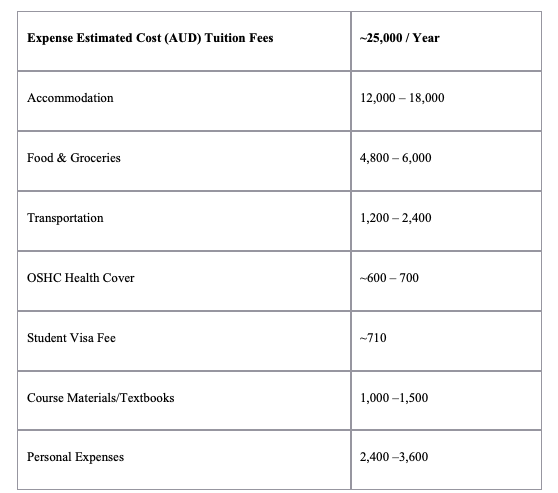
The Australian government estimatesliving expenses at AUD 24,505 per year, but actual costs vary by cityand lifestyle. Some cities like Sydney or Melbourne are more expensive thanregional areas, so it's important to consider this when budgeting for yourstudies. Additionally, part-time work opportunities can help offset costs. Keepin mind that as an international student, you may have restrictions on thenumber of hours you can work per week. It's essential to research theseregulations beforehand to ensure compliance with your visa requirements. Livingcosts in Australia can vary based on various factors such as accommodation,transportation, food, and social activities. Rent typically constitutes asignificant portion of the expenses, with shared accommodation being a moreaffordable option compared to renting a place on your own. Publictransportation is generally efficient and cost-effective, while dining outfrequently can quickly add up expenses. Exploring student discounts and cookingat home can help manage food costs. It's crucial to create a budget and trackyour expenses diligently to ensure financial stability throughout your studies.
Rentdepends on location:
Regionalcities offer lower rents.
Budgetaround:
Includephone bills, clothing, entertainment—expect about AUD 200–300 monthly.
Internationalstudents must have Overseas Student Health Cover (OSHC) during their stay.
The fee for a student visa isapproximately AUD 710.
Youmust prove sufficient funds to cover:
Proofincludes bank statements showing funds held for at least three months orapproved loans/scholarships. The Department requires genuine financial backing— borrowed money deposited days before applying won’t suffice.
Total:Around AUD 47,710 to AUD 58,910 per year depending on lifestyle andlocation.
Lookout for scholarships such as:
Student visas allow working up to 48hours per fortnight during semesters and unlimited hours during breaks.Jobs include retail assistantship or campus roles paying around AUD20–30/hour,helping offset living costs.
Global Select Education specializesin guiding Nepali students through Australian study pathways with clear costbreakdowns and trusted support including visa assistance. They ensure youunderstand all expenses upfront so there are no surprises after arrival.
Witha strong reputation for providing reliable and comprehensive support, GlobalSelect Education is dedicated to making your transition to studying inAustralia as smooth as possible. Their experienced team will assist you withvisa processes, ensuring you meet all the necessary requirements. By offeringdetailed cost breakdowns upfront, they help you plan your finances effectively,minimizing any potential financial stress. With their extensive network ofpartner institutions, they can help you find the right course that suits yourinterests and career goals. Trustworthy and transparent, Global SelectEducation is your ideal partner in navigating the Australian education system.rexperienced team will assist you with visa processes, ensuring you meet all thenecessary requirements. By offering detailed cost breakdowns upfront, they helpyou plan your finances effectively, minimizing any potential financial stress.With their extensive network of partner institutions, they can help you findthe right course that suits your interests and career goals. Trustworthy andtransparent, Global SelectEducation is your ideal partner in navigating the Australian educationsystem. Whether it's providing guidance on choosing the right study program orassisting with accommodation arrangements, their dedicated team is committed toensuring a seamless and successful transition for Nepali students. So why wait?Take the first step towards your Australian dream by reaching out to GlobalSelect Education today!

Education plays a pivotal role in shaping the future of individuals and societies and when it comes to fostering excellence and innovation, few countries can match the reputation of the Australian education system. From the early years of childhood development to advanced tertiary education, Australia has long been committed to providing a comprehensive and high-quality educational experience.

If you are a Nepali student planning Australia, the “work hours” question comes up almost immediately.Because it is not just about extra pocket money. It is rent. Groceries. Transport. Phone bill. Sometimes, helping family back home too. And also, you do not want to mess up your visa conditions by accident, which happens more often than people admit.So let’s keep this simple, accurate, and actually useful.

More Nepali students than ever are heading to the UK—and for good reason. It’s not just about degrees anymore. It’s about global exposure, career-ready skills, and real opportunities. From top universities and shorter course durations to post-study work visas and scholarships, this blog explores why the UK remains a top destination in 2025. Discover the benefits, challenges, and emerging trends every Nepali student should know before taking the leap.
| Course | Bachelor’s Degree | Master’s Degree | Requirements or Considerations | English Language Proficiency (IELTS/TOEFL) | Tuition Fees (per year for international students) | Top Universities |
|---|---|---|---|---|---|---|
Nursing | 3 years | 1-2 years | Clinical placements required; may need specific health immunizations. | Minimum IELTS 6.5; TOEFL 79-93. | AUD $30,000 - $45,000 | University of Sydney, University of Melbourne, Monash University |
Information Technology | 3-4 years | 1-2 years | May require programming skills or prior coursework in IT. | Minimum IELTS 6.5; TOEFL 79-93. | AUD $30,000 - $50,000 | Australian National University, University of New South Wales, University of Melbourne |
Accounting | 3 years | 1-2 years | Need to meet accreditation standards by professional bodies. | Minimum IELTS 6.5; TOEFL 79-93. | AUD $30,000 - $40,000 | University of Melbourne, University of Sydney, University of Queensland |
Engineering (various fields) | 4 years | 1-2 years | Strong background in mathematics and physics required. | Minimum IELTS 6.5; TOEFL 79-93. | AUD $35,000 - $45,000 | University of New South Wales, University of Sydney, Monash University |
Social Work | 4 years | 1-2 years | Practical experience or placements required. | Minimum IELTS 7.0; TOEFL 94-101. | AUD $28,000 - $40,000 | University of Melbourne, University of Sydney, University of Queensland |
Education (various fields) | 4 years | 1-2 years | A police clearance and working with children check required. | Minimum IELTS 7.0; TOEFL 94-101. | AUD $28,000 - $35,000 | University of Melbourne, University of Sydney, Monash University |
Psychology | 3 years | 1-2 years | Requires strong research and psychological theory understanding. | Minimum IELTS 7.0; TOEFL 94-101. | AUD $30,000 - $45,000 | University of Sydney, University of New South Wales, University of Queensland |
Occupational Therapy | 3-4 years | 1-2 years | May require pre-registration or relevant clinical experience. | Minimum IELTS 7.0; TOEFL 94-101. | AUD $30,000 - $45,000 | University of Queensland, University of Sydney, Curtin University |
Architecture | 3-4 years | 2 years | Includes technical and creative coursework, portfolio may be required. | Minimum IELTS 6.5; TOEFL 79-93. | AUD $35,000 - $50,000 | University of Sydney, University of Melbourne, Monash University |
Medicine and Health Sciences | 5-6 years | 2-4 years | Highly competitive entry, includes clinical placements and internships. | Minimum IELTS 7.0; TOEFL 94-101. | AUD $45,000 - $70,000 | University of Melbourne, University of Sydney, Australian National University |
| State/Territory | Subclass 190 (Skilled Nominated Visa) | Subclass 491 (Skilled Work Regional (Provisional) Visa) |
|---|---|---|
| New South Wales (NSW) | Required for some occupations | Required for some occupations and regions |
| Victoria (VIC) | Required | Required |
| Queensland (QLD) | Not typically required, conditions apply | Required for some occupations and regions |
| South Australia (SA) | Not typically required, conditions apply | Required for some occupations and regions |
| Western Australia (WA) | Not typically required | Not typically required |
| Tasmania (TAS) | Not typically required, conditions apply | Not typically required, conditions apply |
| Northern Territory (NT) | Not typically required | Not typically required |
| Australian Capital Territory (ACT) | Required, uses Matrix system | Required, uses Matrix system |
Claim your
from us!

Copyright © 2025, Global Select Education and Migration Services. All Rights Reserved. MARN: 2217810, 2418520 | PAN: 610211842
